Table of Contents
More Than Nets and a Cricket Kit
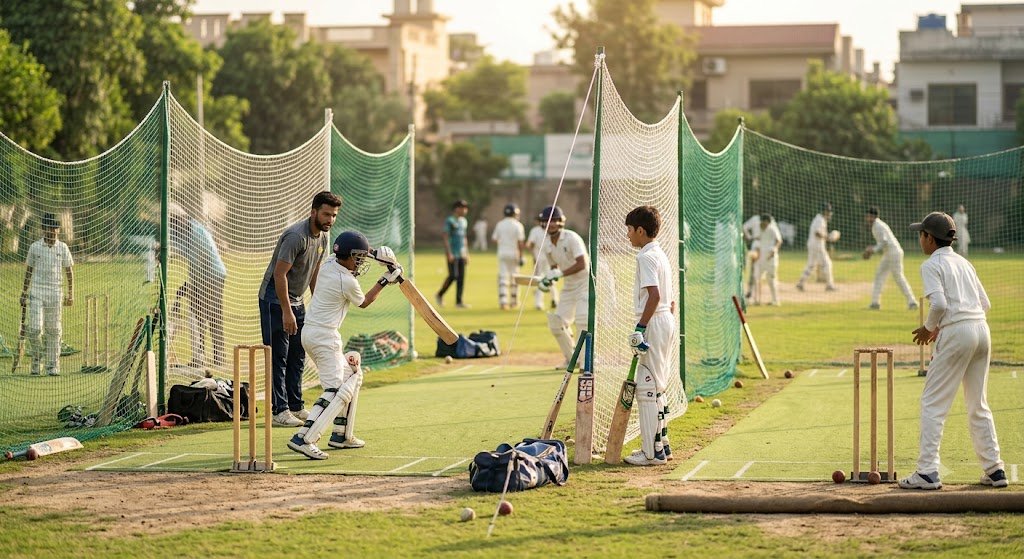
In Lahore, a child’s cricket journey can begin almost anywhere: on a school ground, in a narrow street, or with a plastic bat in the family’s courtyard. But there comes a time when casual play is no longer enough. The child needs someone to correct the grip, explain footwork, improve bowling rhythm, and teach the difference between playing hard and playing intelligently.
That is where a good cricket academy becomes important.
However, choosing an academy is not simply a matter of asking, “Which one is the most famous?” The better question is: Which academy is right for this particular child? A seven-year-old beginner needs fun, confidence, and basic coordination. A 16-year-old club player needs specialist coaching, fitness training, match pressure, and a pathway to higher-level cricket.
This guide examines some of Lahore’s notable cricket academies for junior players and explains what parents should consider before paying the admission fee.
Editorial note: This is a practical guide, not an official ranking. Fees, batches, coaches, venues, and admission policies can change, so parents should confirm current details directly with each academy.
What Parents Should Look For
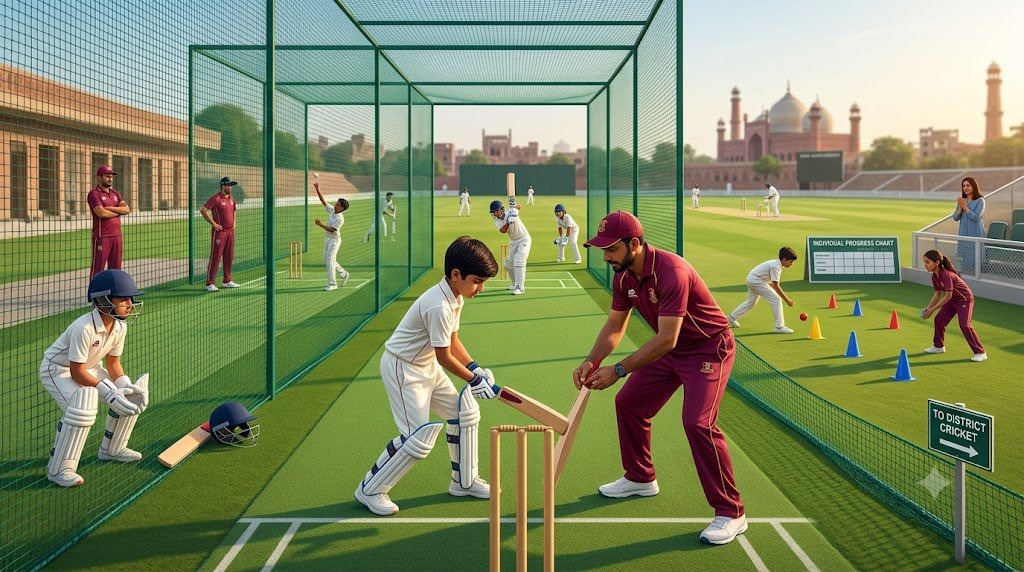
A cricket academy should offer more than a row of nets and a coach feeding balls to children. A useful junior programme normally includes:
- Batting, bowling, wicketkeeping, and fielding practice.
- Age-based groups instead of placing all children together.
- Regular matches and match simulations.
- Coaches who teach technique patiently.
- Fitness and mobility exercises suitable for young bodies.
- Safe equipment and responsible supervision.
- Feedback that helps a player understand what to improve.
- A realistic route toward school, club, district, or regional cricket.
The Pakistan Cricket Board’s player-development work focuses on identifying talent at an early age and developing technical, physical, mental, and tactical qualities. That is an important reminder for parents: a child’s value should not be judged only by runs scored in one trial match.
1. Aleem Dar Cricket Academy
A structured starting point for young players
Aleem Dar Cricket Academy is associated with former international umpire Aleem Dar and presents itself as a junior-focused training centre in Lahore. Its official information mentions players from approximately 7 to 19 years of age, with coaching in batting, bowling, fielding, net practice, and match play.
For a young player, the academy’s broad approach may be useful. A child should not be pushed into becoming only a batter or only a fast bowler too early. At the beginner stage, it is better to develop hand-eye coordination, throwing, catching, running between the wickets, and enjoyment of the game.
The academy also states that it supports hearing-impaired players through free coaching and scholarships. This is a meaningful feature because it suggests that cricket can be used not only as a competitive activity but also as a way to build confidence and inclusion.
Best suited to: Beginners, school-age players, and children who need a structured introduction to hard-ball cricket.
What to ask before joining: Are beginners separated from advanced players? How many children are in each batch? Are matches held regularly or only occasional net sessions?
2. Lahore Qalandars High-Performance Centre
For children who want a competitive pathway
The Lahore Qalandars High-Performance Centre is a natural choice for families interested in a more competitive development route. Its official platform lists pathways for U-12, U-15, U-18, and adult players. It also refers to academy tournaments in T10, T20, ODI, and two-day red-ball formats.
This variety is important. T20 cricket teaches quick decisions and aggressive intent, while two-day cricket teaches patience, concentration, and the value of building an innings. A junior player who experiences different formats can become more adaptable instead of learning only one style of cricket.
The centre’s registration information identifies its location at Kingston, Upper Canal Road, Jallo, Lahore.
Best suited to: Players who already understand basic cricket and want regular competition, age-group development, and exposure to a professional-style environment.
What to ask before joining: Is selection based on open admission or trials? What tournaments are available for each age group? Will the player receive individual performance feedback?
3. National Cricket Academy
The elite-development option
The National Cricket Academy is different from a typical neighbourhood cricket academy. It operates under the Pakistan Cricket Board and is described by the PCB as a high-performance centre and a finishing school for Pakistan’s elite youth teams.
Its programmes have included technical coaching, physical preparation, health and nutrition, education, and specialized training. This makes the NCA especially relevant to players who have already demonstrated ability in school, club, district, or regional cricket.
For parents of beginners, it is important to understand that the NCA should not automatically be treated as a normal daily coaching academy. Access may depend on selection, camps, development programmes, or invitations. The PCB has, for example, conducted skills-development camps in Lahore for selected players.
Best suited to: Advanced junior cricketers and players already competing at a serious level.
What to ask before joining: Is a current camp or programme open for applications? What are the selection criteria? Is the opportunity for regular coaching or a limited-duration camp?
4. PakLions International Cricket Academy
A practical option for match experience
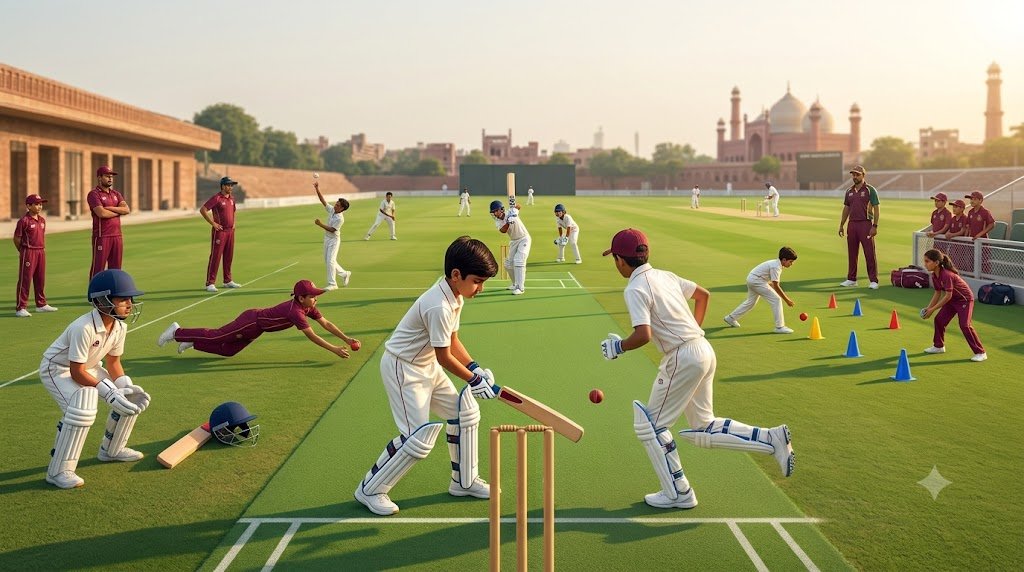
PakLions International Cricket Academy highlights junior coaching, teamwork, technical development, and tournament opportunities. Its official website lists training locations or venues in areas including Kalma Chowk, DHA Phase 1, DHA Phase 6, Engineers Town, and Jubilee Town. It also describes monthly tournaments at venues around Lahore.
For many children, match practice is the missing part of cricket development. Nets can make a player look technically sound, but matches reveal how the player reacts to pressure. Can a batter rotate the strike after losing an early wicket? Can a bowler change the plan when the batter attacks? Can a fielder stay alert during the final overs?
A programme that gives children regular opportunities to answer these questions can accelerate their learning.
Best suited to: Beginners and intermediate players who want group coaching and frequent games.
What to ask before joining: Which venue will the child attend? How often are matches played? Are tournaments organized by age group, and are all players given meaningful opportunities?
5. Azhar Ali Cricket Academy
Technical guidance for serious learners
Azhar Ali Cricket Academy is linked with former Pakistan Test captain Azhar Ali and has been associated with a facility in Valencia Town, Lahore. Public information about the academy has mentioned coaching support, a physiotherapist, and video analysis.
Video analysis can be especially valuable for teenage players. A coach can show a batter why the head is falling away from the ball or demonstrate how a bowler’s front-arm position affects control. This turns vague advice such as “play straight” or “improve your action” into something the player can see and understand.
The presence of performance support can also help older players learn about injury prevention, recovery, and fitness. Nevertheless, the quality of the experience will depend on the current coaching team, batch size, and programme structure.
Best suited to: Intermediate and advanced players who want technical correction and performance-focused coaching.
What to ask before joining: Is video analysis available to every player or only selected groups? Is a physiotherapist present regularly? How is progress measured?
6. PakLand Cricket Academy
A choice for age-group development
PakLand Cricket Academy advertises training for young players in age groups including under-10, under-13, and under-16. Age-based coaching is useful because a child’s physical development, attention span, and technical needs change considerably between these stages.
An under-10 player may need fun drills, basic movement, catching games, and confidence-building exercises. An under-16 player may require specialist batting or bowling work, tactical awareness, strength training, and tournament exposure. A programme that recognizes these differences is more useful than one general session for everyone.
Best suited to: Families specifically looking for under-10, under-13, or under-16 training groups.
What to ask before joining: How are players assessed? Are age groups divided further by ability? How often do students play competitive matches?
A Realistic Example
Imagine a 10-year-old boy named Hamza who loves batting but becomes nervous when facing a hard cricket ball. His parents initially consider joining the most prestigious academy in Lahore, but the long travel time means he would miss schoolwork and arrive tired.
A smaller academy near home may be the better choice for Hamza. During his first year, his main goals should be learning a safe batting stance, watching the ball, improving catching, bowling regularly, and playing without fear. If he attends consistently and receives personal attention, he may progress faster than he would in a crowded, distant programme.
Now consider 15-year-old Areeba, who already plays school cricket and wants to become a specialist fast bowler. Her needs are different. She may benefit from an academy offering speed development, workload monitoring, video feedback, match analysis, and competitive fixtures. For her, the academy’s pathway and coaching expertise matter more than beginner-friendly facilities.
My Opinion: The Best Academy Is the Best Fit
In my opinion, the biggest mistake parents make is choosing an academy based only on a famous name, expensive facilities, or promises of professional selection. No academy can guarantee that a child will become a national cricketer. What it can provide is a better environment in which the child can learn, compete, and discover his or her ability.
Parents should attend a session before enrolling. They should watch how coaches speak to weaker players, whether children spend most of the session waiting in line, and whether the training includes fielding and match situations. A coach who gives honest, respectful feedback is usually more valuable than one who makes unrealistic promises.
Travel time also matters. A player who trains twice a week consistently will often improve more than one who attends an elite academy irregularly. The best academy is therefore not necessarily the one with the biggest ground; it is the one where the child receives proper attention and continues enjoying the game.
Questions to Ask Before Paying Fees
Before admission, parents should ask:
- What age and skill group is suitable for my child?
- How many players are in each batch?
- Who will coach the group?
- How much time is spent on batting, bowling, and fielding?
- Are proper matches organized regularly?
- Are fitness exercises safe for children?
- What are the admission, monthly, kit, and tournament charges?
- Is there a trial session?
- How does the academy provide progress feedback?
- What pathway exists for school, club, district, or regional cricket?
Conclusion
Lahore provides several options for junior cricketers, including Aleem Dar Cricket Academy, Lahore Qalandars High-Performance Centre, the National Cricket Academy, PakLions International Cricket Academy, Azhar Ali Cricket Academy, and PakLand Cricket Academy. They do not all serve the same purpose: some are better for beginners, some for match experience, and others for advanced performance development.
The right decision should be based on the child’s age, current skill, goals, school routine, travel distance, and personality. Parents should visit the academy, observe a session, compare the coaching environment, and confirm current information before enrolling.
Most importantly, junior cricket should remain a learning journey rather than a race for selection. The child who enjoys practice, learns from mistakes, respects teammates, and continues working patiently has already gained something more valuable than a trophy: the foundation of a real sporting character.
Best Cricket Academies for Junior Players in Lahore
For best academic for cricket to visit my site